Showing posts with label Australia. Show all posts

Monday, 20 August 2012

Queen Victoria Building


Best Historic Place Ever........


        The Queen Victoria Building is both a magnificent historical landmark and a shopping paradise. Affectionately referred to as the QVB, it has been described as the “most beautiful shopping centre in the world” by Pierre Cardin. It is a hub of activity and attracts hundreds of locals and tourists every day.

Exterior 


History Of The QVB

            The Queen Victoria Building was built on the site of the George Street Markets, Sydney’s produce markets in the 1800s. Architect George McRae submitted four separate designs for the building to the Sydney City Council, each with their own style. The styles were Renaissance, Gothic, Romanesque Revival and Queen Anne. Ultimately, the Romanesque Revival style was chosen. Construction began in 1893.
          Sydney was in the midst of a recession in 1893 and many people were out of work. The building project provided many job opportunities, especially for construction workers and artists and gave some much needed relief for many families.
Construction was completed in 1898 and the building was named after Queen Victoria, the reigning monarch at the time. It originally featured coffee shops, showrooms, a business environment for various tradesmen and a concert hall. The concert hall has since become a library.
              Several alterations were made over the following years. For example, the original concept of a glass-roofed shopping street was lost when much of the building was converted into office space. Sadly, as time went on the building slowly deteriorated and in 1959, it was threatened with demolition.
Thankfully, the building was rescued and underwent extensive restorations and refurbishment. It was reopened in 1984 and although it is now home to over 200 modern shops, it still retains its turn-the-century charm.


The Architecture

              The architecture of the Queen Victoria Building is stunning both inside and out and offers a unique contrast to the surrounding modern structures. Even if you do not wish to shop, it is worth the time to have a look around.
From the outside you will notice the large central dome. It is 20 metres in diameter and is made up of an inner glass dome and an exterior copper-sheathed dome, topped by a domed cupola. Other smaller domes also feature prominently along the roof.

               At the main entrance is a statue of Queen Victoria by Irish sculptor, John Hughes. The statue once stood outside the Irish Houses of Parliament in Leinster House, Dublin but in 1947 it was given to the people of Sydney by the Government of the Republic of Ireland. It was placed here in 1987.
              The Royal Wishing Well stands nearby. It features a bronze sculpture of Islay, Queen Victoria’s favourite dog. A recorded message by radio personality, John Laws encourages passers-by to make a donation in the well, with all proceeds going to deaf and blind children.
Inside the Queen Victoria Building you will find beautiful wood panelling, sweeping staircases and stunning stained-glass windows, including a window featuring the original crest of arms of the city of Sydney. While you are there, make sure you look down at the tiles on the mosaic floor. Many are the originals.
             The upper levels of the building overlook the ground floor, creating a beautiful open space full of charming shops and cafes. If you have time, try one of the cafes on the upper levels and relax as you people-watch in exquisite surroundings.

Interior


Interior displays


            Two mechanical clocks, each one featuring dioramas and moving figures from moments in history, can be seen from the adjacent railed walkways. The Royal Clock activates on the hour and displays six scenes of English royalty (accompanied by a trumpet voluntary written by Jeremiah Clarke). The Great Australian Clock, designed and made by Chris Cook, weighs four tonnes and stands ten metres tall. It includes 33 scenes from Australian history, seen from both Aboriginal and European perspectives. An Aboriginal hunter circles the exterior of the clock continuously, representing the never-ending passage of time.
           The building also contains many memorials and historic displays. Of these, two large glass cases, removed in 2009-2010, stood out. The first display case contained an Imperial Chinese Bridal Carriage made entirely of jade and weighing over two tonnes, the only example found outside China. The second was a lifesize figure of Queen Victoria in a replica of her Coronation regalia, and surrounded by replicas of the British Crown Jewels. Her enthroned figure rotated slowly throughout the day, fixing the onlooker with her serene and youthful gaze.
          On the top level near the dome is displayed a sealed letter which is to be opened in 2085 by the future Lord Mayor of Sydney and read aloud to the People of Sydney. It is written by Queen Elizabeth II in 1986 and no one except her knows what is written


Designers

               George McRae was born in Edinburgh in 1858. He arrived in Sydney in 1884 and was appointed Assistant Architect in the City Architect’s office. He became City Architect and City Building Surveyor in 1889, a position he held until 1897 when he was appointed Principal Assistant Architect to Vernon in the Government Architect’s Branch. He succeeded Vernon as Government Architect in 1912 and held the office until his death in 1923.
Works undertaken by McRae during his term as Government Architect included the Education Dept Building 1912; Parcels Post Office 1913; Taronga Zoo lower entrance, top entrance, and Indian elephant house; additions to the Colonial Treasury Building in Bridge Street, and Cessnock Court House.
             From 1912 until 1937 the Government Architect’s Branch was housed in the “Tin Shed”, a temporary building on the site of the first Government House and demolished in 1970.


Monday, 23 July 2012

Opera House


Opera House, Australia


          The Sydney Opera House is a multi-venue performing arts centre in Sydney, New South Wales, Australia. It was conceived and largely built byDanish architect Jørn Utzon, opening in 1973 after a long gestation that had begun with his competition-winning design in 1957.Utzon received the Pritzker Prize, architecture's highest honour, in 2003. The Pritzker Prize citation stated:There is no doubt that the Sydney Opera House is his masterpiece. It is one of the great iconic buildings of the 20th century, an image of great beauty that has become known throughout the world – a symbol for not only a city, but a whole country and continent.The Sydney Opera House was made a UNESCO World Heritage Site on 28 June 2007. It is one of the 20th century's most distinctive buildings and one of the most famous performing arts centres in the world.The Sydney Opera House is on Bennelong Point in Sydney Harbour, close to the Sydney Harbour Bridge. It sits at the northeastern tip of theSydney central business district (the CBD), surrounded on three sides by the harbour (Sydney Cove and Farm Cove) and inland by the Royal Botanic Gardens.


              Contrary to its name, the building houses multiple performance venues. The Sydney Opera House is among the  busiest performing arts centres in the world, hosting over 1,500 performances each year attended by some 1.2 million people. It provides a venue for many performing-arts companies, including the four key resident companies Opera Australia, The Australian Ballet, the Sydney Theatre Company and the Sydney Symphony Orchestra, and presents a wide range of productions on its own account. It is also one of the most popular visitor attractions in Australia, with more than seven million people visiting the site each year, 300,000 of whom take a guided tour. 


              The Sydney Opera House is a modern expressionist design, with a series of large precast concrete "shells", each composed of sections of asphere of 75.2 metres (246 ft 8.6 in) radius, forming the roofs of the structure, set on a monumental podium. The building covers 1.8 hectares (4.4 acres) of land and is 183 m (600 ft) long and 120 m (394 ft) wide at its widest point. It is supported on 588 concrete piers sunk as much as 25 m (82 ft) below sea level.

              Although the roof structures of the Sydney Opera House are commonly referred to as "shells" (as they are in this article), they are in fact not shells in a strictly structural sense, but are instead precast concrete panels supported by precast concrete ribs.]The shells are covered in a subtle chevron pattern with 1,056,006 glossy white- and matte-cream-coloured Swedish-made tiles from Höganäs AB, a factory that generally produced stoneware tiles for the paper-mill industry.  though, from a distance, the shells appear a uniform white.

          Apart from the tile of the shells and the glass curtain walls of the foyer spaces, the building's exterior is largely clad with aggregate panels composed of pink granite quarried at Tarana. Significant interior surface treatments also include off-form concrete, Australian white birch plywoodsupplied from Wauchope in northern New South Wales, and brush box glulam. 

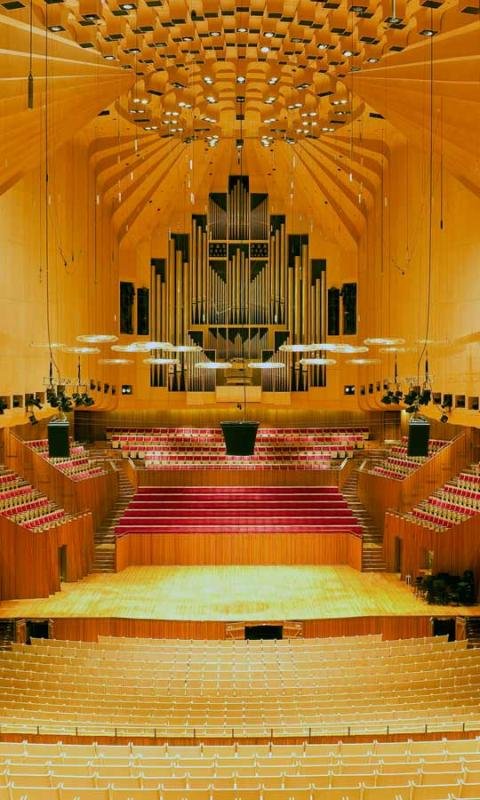
             Of the two larger spaces, the Concert Hall is located within the western group of shells, and the Opera Theatre within the eastern group. The scale of the shells was chosen to reflect the internal height requirements, with low entrance spaces, rising over the seating areas and up to the high stage towers. The smaller venues (the Drama Theatre, the Playhouse, and The Studio) are located within the podium, beneath the Concert Hall. A smaller group of shells set to the western side of the Monumental Steps houses the Bennelong Restaurant. The podium is surrounded by substantial open public spaces, of which the large stone-paved forecourt area with the adjacent monumental steps is also regularly used as a performance space.


Interiors of Sydney Opera House


Interiors of Sydney Opera House


           Stage III, the interiors, started with Utzon moving his entire office to Sydney in February 1963. However, there was a change of government in 1965, and the new Robert Askin government declared the project under the jurisdiction of the Ministry of Public Works. This ultimately led to Utzon's resignation in 1966 (see below).
           The cost of the project so far, even in October 1966, was still only $22.9 million, less than a quarter of the final $102 million cost. However, the projected costs for the design were at this stage much more significant.
           The second stage of construction was progressing toward completion when Utzon resigned. His position was principally taken over by Peter Hall, who became largely responsible for the interior design. Other persons appointed that same year to replace Utzon were E. H. Farmer as government architect, D. S. Littlemore and Lionel Todd.
           Following Utzon's resignation, the acoustic advisor, Lothar Cremer, confirmed to the Sydney Opera House Executive Committee (SOHEC) that Utzon's original acoustic design only allowed for 2000 seats in the main hall and further stated that increasing the number of seats to 3000 as specified in thebrief would be disastrous for the acoustics. According to Peter Jones, the stage designer, Martin Carr, criticised the "shape, height and width of the stage, the physical facilities for artists, the location of the dressing rooms, the widths of doors and lifts, and the location of lighting switchboards."

                       GREAT TO WATCH IT..