Showing posts with label Dubai. Show all posts

Monday, 23 July 2012

Burj khalifa


Burj khalifa


Construction Photo


Tom Cruise Stunt


Burj Khalifa - previously called the Burj Dubai Our good ole city of Dubai is known for setting the standard and breaking records in terms of construction and architecture, and it is not surprising that the city houses the tallest building in the world as of 2010.

The Burj Khalifa, the world’s tallest skyscraper, is the magnificent centerpiece of Downtown Dubai as you can see it.

 The Burj graces the city’s skyline and is surrounded by entertainment centers, shopping destinations, and various first-class hotels in Dubai.It is the tallest among all the Dubai towers.

The construction of the building began on September 21, 2004, and was completed on October 1, 2009.

The building was officially opened on January 4, 2010.
The Burj is a part of the 490-acre flagship development named Downtown Burj Khalifa or Downtown Dubai, located at the “First Interchange” along Sheikh Zayed Road, adjacent to Dubai’s main business district.

The primary contractor for the construction of the building was Samsung C&T of South Korea, who also built the Petronas Twin Towers and the Taipei 101. The Burj is more than just the world’s tallest building.

It is a living wonder, a spectacular work of art, and an incomparable accomplishment of engineering. As of 2010, the Burj has no equal in terms of concept and execution. Kish and I witnessed the construction of this gigantic structure throughout before its official launch.

This wondrous structure is an unparalleled example of global collaboration, an emblematic symbol of progress, and a sign of the new, vibrant, and thriving Middle East.

In less than 30 years, the city transformed from being a regional center to a global city.

The Burj embodies this success which is not brought about by oil reserves, but by ingenious and innovative human talent.
Dubai is notorious for this!

The building is over 800 meters and more than 160 stories tall, and holds the following world records as of 2010: tallest skyscraper to top of spire, tallest structure ever built, tallest extant structure, tallest freestanding structure, building with most floors, world's highest elevator installation, situated inside a rod at the very top of the building, world's fastest elevators at speed of 64 km/h, highest vertical concrete pumping (for a building and any construction), the first world's tallest structure in history to include residential space, and the highest outdoor observation deck in the world.

Here is a picture from the peak of the Burj Khalifa taken by a construction worker during its build-out. The tower is so high, you can actually see the surface of the earth as it curves round. 

While it is unmatched in every aspect, it is the exceptional design of Burj Khalifa that really sets it apart. The architecture features a triple-lobed footprint, which is inspired by the Hymenocallis flower. The tower consists of three elements arranged around a central core.

The modular, Y-shaped structure, with setbacks along each of its three wings provides a naturally stable arrangement for the structure and provides good floor plates. Twenty-six helical levels reduce the cross section of the tower incrementally as it spirals skyward.

The central core surfaces at the top and concludes in a sculpted spire. A Y-shaped floor plan extends views of the Arabian Gulf. Viewed from the base or the air, Burj Khalifa is reminiscent of the onion domes widespread in Islamic architecture. Don’t mean to get all Shakesperean on you, but this structure truly amazes me.

Over 40 wind tunnel tests were conducted on Burj Khalifa to test the effects the wind would have on the tower and its occupants. These ranged from initial tests to validate the wind climate of Dubai, to large structural analysis models and facade pressure tests, to micro-climate analysis of the effects at terraces and around the tower base. Even the temporary conditions during construction were tested with the tower cranes to ensure safety at all times.

Concourse level to level 8 and level 38 and 39 will feature the Armani Hotel Dubai, decorated by couture designer, Giorgio Armani. Levels 9 to 16 will exclusively house plush one and two bedroom Armani Residences. Based on how much the construction plans and dates had changed, I wouldn’t be surprised if these tentative plans shift around as well.

Floors 45 through 108 contain private ultra-luxury residences. The Corporate Suites occupy most of the remaining floors, except for level 122 which is a restaurant and level 124, the tower's public observatory.

The Burj Khalifa was formerly known as Burj Dubai, and was renamed during the opening ceremony in honor of the current President of the UAE and ruler of Abu Dhabi, Sheikh Khalifa bin Zayed al Nahyan. The reason? Rumor is that Dubai didn’t have the money to finish the construction amidst the global economic crisis that hit in 2008. Abu Dhabi came to the rescue to ensure completion of the project.

When you visit Dubai, The Burj Khalifa is one city structure that is impossible to miss. Definitely highly recommended!  

Palm Island


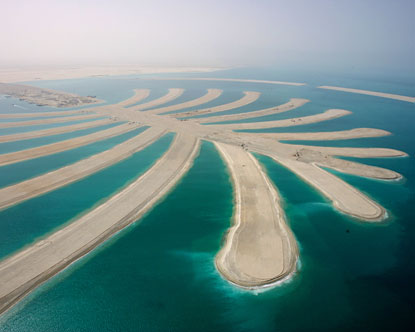
Palm Island Dubai


The Palm Islands are artificial peninsulas constructed of sand dredged from the bottom of the Persian Gulf by the Belgian company Jan De Nul and the Dutch company Van Oord.
The sand is sprayed by the dredging ships, which are guided by DGPS, onto the required area in a process known as rain-bowing because of the arcs in the air when the sand is sprayed. The outer edge of each Palm’s encircling crescent is a large rock breakwater. The breakwater of the Palm Jumeirah has over seven million tons of rock.
Each rock was placed individually by a crane, signed off by a diver and given a GPS coordinate. The Jan De Nul Group started working on the Palm Jebel Ali in 2002 and had finished by the end of 2006. The reclamation project for the Palm Jebel Ali includes the creation of a four-kilometre-long peninsula, protected by a 200-metre-wide, seventeen-kilometre long circular breakwater.
210,000,000 m3 of rock, sand and limestone were reclaimed (partly originating from the Jebel Ali Entrance Channel dredging works). There are approximately 10,000,000 cubic metres of rocks in the slope protection works.

Burj Al Arab


Burj Al Arab


Burj Al Arab Tower of the Arabs

Architect-Tom Wills-Wright (WS Atkins),The interior was designed by Khuan Chew, Design Principal of KCA International (London).
Date- 1994-1999
Style-Postmodern
Construction -321 m The Burj Al Arab is the world's tallest hotel. 5 stars*  No. of rooms 202
Antenna/Spire 321 m (1,053 ft) Roof 210 m (689 ft)
Top floor 200 m (656 ft) Floor count 60
Floor area 111,500 m² (1,2000,000 sq ft)

Elevator count 18 
Type-Hotel

The Burj Al Arab (Arabic: برج العرب, "Tower of the Arabs") is a luxury hotel in Dubai, United Arab Emirates managed by the Jumeirah Group and built by Said Khalil. It was designed by Tom Wright of WS Atkins PLC. At 321 metres (1,053 ft), it is the tallest building used exclusively as a hotel. However, the Rose Tower, also in Dubai, which has already topped Burj Al Arab's height, will take away this title upon its opening in April 2008. The Burj Al Arab stands on an artificial island 280 metres (919 ft) out from Jumeirah beach, and is connected to the mainland by a private curving bridge. It is an iconic structure, designed to symbolize Dubai's urban transformation and to mimic the billowing sail of a boat.

Construction
Construction of Burj Al Arab began in 1994. It was built to resemble the sail of a dhow, a type of Arabian vessel. Two "wings" spread in a V to form a vast "mast", while the space between them is enclosed in a massive atrium. Architect Tom Wright said "The client wanted a building that would become an iconic or symbolic statement for Dubai; this is very similar to Sydney with its Opera House, or Paris with the Eiffel Tower. It needed to be a building that would become synonymous with the name of the country."

The architect and engineering consultant for the project was Atkins, the UK's largest multidisciplinary consultancy. The hotel was built by South African construction contractor Murray & Roberts.The hotel cost $650 million to build.

Features
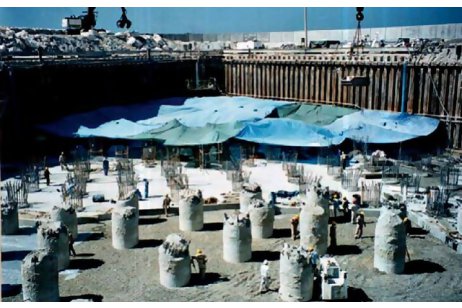
Several features of the hotel required complex engineering feats to achieve. The hotel rests on an artificial island constructed 280 meters offshore. To secure a foundation, the builders drove 230 40-meter long concrete piles into the sand. The foundation is held in place not by bedrock, but by the friction of the sand and silt along the length of the piles.

Engineers created a surface layer of large rocks, which is circled with a concrete honey-comb pattern, which serves to protect the foundation from erosion. It took three years to reclaim the land from the sea, but less than three years to construct the building itself. The building contains over 70,000 cubic meters of concrete and 9,000 tons of steel.


Inside the building, the atrium is 180 meters (590 ft) tall. During the construction phase, to lower the interior temperature, the building was cooled by half-degree increments over a period of three to six months. This was to prevent large amounts of "condensation or in fact even a rain cloud from forming in the hotel during the period of construction." This task was accomplished by several cold air nozzles, which point down from the top of the ceiling, and blast a 1 meter cold air pocket down the inside of the sail. This creates a buffer zone, which controls the interior temperature without massive energy costs.[citations needed]

Burj Al Arab characterizes itself as the world's only "7-star" property, a designation considered by travel professionals to be hyperbole. All major travel guides and hotel rating systems have a 5-star maximum, which some hotels attempt to out-do by ascribing themselves "6-star" status. Yet according to the Burj Al Arab's official site, the hotel is a "5-star deluxe hotel". It is the world's tallest structure with a membrane façade and the world's tallest hotel (not including buildings with mixed use) and was the first 5-star hotel to surpass 1,000 ft (305 m) in height. Although it is characterized as the world's only 7-Star Hotel, several "7 Star" hotels are under construction. These include the Flower of the East under construction in Kish, Iran, The Centaurus Complex under construction in Islamabad, Pakistan and a complex planned for Metro Manila in the Philippines.
Construction photo

Base of Al Arab


Exterior

The Burj Al Arab artificial island
The building design features a steel exoskeleton wrapped around a reinforced concrete tower. Notably the building is shaped like the sail of a dhow, with two "wings" spread in a V to form a vast "mast". The space between the wings is enclosed by a Teflon-coated fibreglass sail, curving across the front of the building and creating an atrium inside. The sail is made of a material called Dyneon, spanning over 161,000 square feet (15,000 m²), consists of two layers, and is divided into twelve panels and installed vertically. The fabric is coated with DuPont Teflon to protect it from harsh desert heat, wind, and dirt; as a result, "the fabricators estimate that it will hold up for up to 50 years."

During the day, the white fabric allows a soft, milky light inside the hotel, whereas a clear glass front would produce blinding amounts of glare and a constantly increasing temperature. At night, both inside and outside, the fabric is lit by color-changing lights. During the period of mourning following the death of Sheikh Maktoum bin Rashid Al Maktoum in January 2006, the light show and some water features were turned off.

Near the top of the building is a suspended helipad supported by a cantilever. The helipad has featured some of the hotel's notable publicity events. Irish singer Ronan Keating shot his music video Iris on the helipad. In March 2004, professional golfer Tiger Woods hit several golf balls from the helipad into the Persian Gulf, while in February 2005, professional tennis players Roger Federer and Andre Agassi played an unranked game on the helipad, which was temporarily converted into a grass tennis court, at a height of 211 meters. The helipad has no borders or fences on the edges and if a player hit a winner the tennis balls would plunge down to the ground.

Interior


The interior was designed by Khuan Chew, Design Principal of KCA International. Other projects by Khuan Chew include the Sultan of Brunei's Palace, Dubai International Airport, Jumeirah Beach Resort Development, Madinat Resort and much more.

The Burj Al Arab features the tallest atrium lobby in the world, at 180 meters (590 ft). The atrium is formed between the building's V-shaped span. The atrium dominates the interior of the hotel, and takes up over one-third of interior space. It can accommodate the Dubai World Trade Center building, which, at 38 stories, was the tallest building in Dubai from the late 1970s to the mid-1990s.

While the exterior of the Burj Al Arab is expressed in terms of ultra-modern sculptural design, the interior guest space is a compilation of lavish and luxurious architectural styles from both the east and the west. The hotel boasts 8,000 square meters of 22-carat gold leaf and 24,000 square meters of 30 different types of marble.

In the mezzanine lobby, a fountain creates a "three-dimensional Islamic star pattern." Pointed arches throughout, found in one of the hotel’s three restaurants, corridors between guest rooms, and at the top of the atrium recall a classic Arabian architectural design form.


Restaurants

One of its restaurants, Al Muntaha (Arabic meaning "Highest" or "Ultimate"), is located 200 meters above the Persian Gulf, offering a view of Dubai. It is supported by a full cantilever that extends 27 meters from either side of the mast, and is accessed by a panoramic elevator.

Another restaurant, the Al Mahara (Arabic "The Oyster"), which is accessed via a simulated submarine voyage, features a large seawater aquarium, holding roughly 35,000 cubic feet (over one million liters) of water. The tank, made of acrylic glass in order to reduce the magnification effect, is about 18 cm (7.5 inches) thick. The restaurant was also voted among the top ten best restaurants of the world by Condé Nast Traveler. They have recently hired acclaimed chef Kevin McLaughlin.


 Rooms and prices

Despite its size, the Burj Al Arab holds only 28 double-story floors which accommodate 202 bedroom suites. The smallest suite occupies an area of 169 square meters (1,819 square ft), the largest covers 780 square meters (8,396 square ft). It is one of the most expensive hotels in the world. The cost of staying in a suite begins at $1,000 per night and increases to over $15,000 per night; the Royal Suite is the most expensive, at $28,000 per night

Suites feature design details that juxtapose east and west. White Tuscan columns and a spiral staircase covered in marble with a wrought-iron gold leaf railing show influence from classicism and art nouveau. Spa-like bathrooms are accented by mosaic tile patterns on the floors and walls, with Arabian-influenced geometries, which are also found elsewhere in the building.